Tuesday, February 1, 2011

Changes in the World

You have probably heard of Martin Luther King and the changes he made in society. He helped the African-American black people gain their rights. You might also have heard of Martin Luther. He is not quite so recent, but he made a lot of important changes in the world that affect you whether you have heard of him or not. And in England, King Henry the 8th was building on those changes, building to his own advantage. In the early middle ages, Catholics were basically the only kinds of Christians, and the pope was the head of the church. This meant that because most people were Catholic, the pope had a lot of power. He could even tell kings what to do! The Catholic church frightened many people into giving them a lot of money, by saying that God would forgive all their sins if they gave a certain amount. That was called "indulgence". Martin Luther read the Bible carefully and he found out that God does not save us if we do good deeds, or if we give a lot of money to the church. God has already saved us, if we will believe in him. Martin Luther wrote a long list of things that were wrong about the Catholic church and indulgences. People began to think about what he was saying, and many of them started to disagree with the Catholics, too.The Catholic church did not like this, but the king of England did.
          The King of England at this time was a man named Henry the eighth. He did not want a war to start after he died over who would become the next king. He wanted his son to get immediate access to the royal throne. But his current wife did not bear him any sons, only a daughter named Mary. Henry wanted to get rid of his wife, and so he had to ask the pope if he was allowed to. But the pope said no, and so Henry got angry. He liked Martin Luther's ideas, that the pope should not always be the one in charge. He quickly told his kingdom that he was the all supreme ruler, and he got to make his own decisions. Now he could divorce his wife, Catherine.

Henry the eighth married again. His new wife, Anne Boleyn, had her head cut off because she did not give him a son either. Just another daughter named Elizabeth.

His third wife was a little luckier. Jane Seymour bore him a son named Edward, but she died in the process.

 Anne of Cleves was next, but Henry didn't like how she looked, so he sent her back to Germany, where she came from. Anne was happy, too. The king was getting old and did not look all that great either.

 Catherine Howard's head was cut off, not to long after she became the fifth wife of the king.


Catherine Parr, the king's 6th and last wife did a good job of taking care of him in his old age. She was also a good nurse to the children. This third Catherine died after Henry the eighth's death.

Susan Wise Bauer has a rhyme to help you remember all Henry King of England's wives.

Divorced, beheaded, died,
Divorced, Beheaded, survived

Martin Luther was not the only one who was changing things. All over Europe, people were settling down, because there was not much war going on, and so they had more time to make art and read. People began to read the manuscripts from the Romans and the Greeks, and so they were able to make science discoveries based on what they learned from the papers. They tried making Roman-style sculptures and painting Greek-style pictures. Architects began to build in the styles that had developed hundreds of years ago. And people began to "relearn" how to read.
 How many books are in your church, your house, your library? Probably more that five, at least, that is what I am guessing. But that is about how many were found in a church, because libraries had not been invented yet, and books were only found in the houses that had very rich owners, because they were very, very expensive.. The books were chained to the wall, so that no one would steal them. A book might take a lifetime to finish. Books were very valuable and very rare, even when the discovery of paper was made by the Egyptians. But one day, a guy called Johannes Gutenberg made a discovery. He learned how to make a printing press. And what is more, he made it out of an old wine press! Because of Gutenberg, books became much easier to make, and so more people were able to have them. They became less expensive, and more people learned to read. I can not now imagine a life without books.
Thursday, January 20, 2011

India, "India," and America

Once, the land of India was split into many different countries. These countries were all ruled by noblemen or small kings. One of these countries was called Delhi. It was ruled by the Sultan of Delhi. India was getting poorer and poorer. It was having trouble ruling itself. It needed a leader. And finally one came. But this ruler was not from India, he was from the Ottoman Turks! His name was Babur. When Babur saw that the Sultan of Delhi was having trouble ruling his kingdom, he decided to conquer it. He had only 12,000 men, and the Sultan had 100000! But his men rode on fast horses, while the Sultan's rode big lumbering elephants. Babur was easily able to conquer Delhi. Then he conquered all the countries around it!   Babur was a good emperor, and while he was a Muslim many of his subjects were Hindus. Babur let them continue doing their own thing, while he did his. Although, he ruled India fairly, he was homesick. He thought India was a dull country, so he planted gardens. All together, Babur ruled in India for four years. Then, he died. His son, Humayan reigned, but was driven out of the country. When he came back, he was not very successful. Finally, he slipped on his library steps, bumped his head, and died. His son, Akbar, was a far better king. He conquered more and more kingdoms until his empire covered half of India!
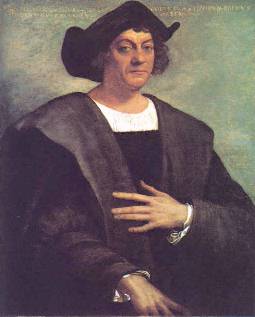
While India was thriving, Europe was looking for it. Traders wanted to find an easier way to get to India than across  Africa. Christopher Columbus thought that the world was round, and so he would get to India if he just sailed West far enough. He was right of course, but he did not know about North and South America. When he finally sailed across the ocean, in ships provided by Queen Isabella of Spain, he thought it was India! He did not find any gold or spices but he did find parrots, peppers, and pineapples, not to mention the "Indians." He made many voyages back and forth but never did he realize it was a new continent. Many other explorers followed in Columbus's wake. Amerigo Vespucci gave America the name it has today. Magellan was the first to sail around the world. Well, he did not make the journey, for stopping to fight in an tribe's war, he was killed. One out of five of his ships came back to Portugal, and from 280 men, there survived less than 36. But he had the idea and that is what counts for a lot.

Wednesday, January 12, 2011

Ferdinand, Isabella, and Mansa Musa

Long ago, Spain conquered Muslim land. After that, there were three countries that made up Spain. But these countries didn't think that they were big enough. One of the kings, whose name was Enrique and who ruled over the small kingdom of Castile, wanted more soldiers so that he could make his army bigger and conquer other kingdoms. He told one of his noblemen Pedro Giron, that if he would give him some soldiers, he might have the king's sister, Isabella, for his wife. Did Isabella like this idea? No! She did not. The nobleman was over forty and she was only thirteen! She had also heard that he was mean and got drunk a lot. But was she asked her opinion? No! She was not. Did Pedro Giron, the nobleman like this idea? Yes, he did. And he was asked, too. Marry the king's sister? Would he like to? Of course! But before the marriage could take place, Pedro Giron died of stomach pains. Isabella was overjoyed! Her brother was not. A few years later, Enrique decided that Isabella would marry the king of Portugal, so that the two kingdoms could become one. Did Isabella like this idea? No she did not. The king of Portugal was old and fat and old enough to be her father!But was Isabella asked what she preferred? No! She was not. And this time she decided to do something about it. So she sent a secret message to the young Prince of Aragon. She had heard, even though they had never met, that he was kind, handsome, and her own age. Ferdinand agreed to come and meet her in a secret place. Four days after they met, they were married. Did Enrique like this idea? No! He did not. But he wasn't asked his opinion either. When Enrique died half a dozen years later, Isabella became queen. In time, Ferdinand also inherited the throne of Aragon. They united the two countries in to one big country of Spain. Later, they also conquered the land of Granada, where many Muslims lived. Now that they owned the whole country of Spain, Ferdinand and Isabella declared it to be and only Christian country. They forced all the Jews to leave. While we remember Ferdinand and Isabella for uniting Spain, which was a good thing, we also remember the horrible thing they did to the Jews in making them leave the land they had lived in for so long.
        While Ferdinand and Isabella were reigning in their Spain, the world of the unknown lay out before them. Most people felt that places like Africa were dark and dangerous. However, the land of Africa thrived in its own special way. In the Middle Ages, much of Africa was roamed by nomadic tribes who lived off the land. But there were also many cities. Three of them were named Ghana, Mali, and Songhay. Ghana became rich and powerful because of the people who traveled through it. Traders carrying gold, salt, and other things to trade were taxed to pass through the city. The city of Ghana did very well for a long time. But then it began to fall apart because its kings would not convert to Islam. Other cities attacked it again and again. It got weaker and weaker. Soon Mali became the more important city. It copied Ghana and taxed the traders who went through. But it was and Islamic kingdom. One of the most famous kings of Mali was a man named Mansa Musa. Not only did he expand his army and his kingdom, he took a pilgrimage to Mecca, the Islamic holy city! That attracted the attention of the world. Soon, maps showed the city of Mali. Because of Mansa Musa, people in the Middle Ages learned about the country of Mali. But after the death of Mansa Musa, the kingdom of Mali began to fade away just like Ghana had. And, like Ghana, it was replaced by a new and larger kingdom. Songhay grew until it covered the entire region of what had once been Mali and Ghana. It had universities in its towns and many, many schools busy marketplaces and temples were also commonly found. The explorer Leo Africanus wrote about his travels in the country of Songhay. His book was called History and Description of Africa and the Notable Things contained therein. He wrote about the capital city of Timbuktu and its inhabitants, what the houses were made of,  and such. I think I would like to read his book.

Thursday, January 6, 2011

2011


Before the new year started, I made a lot of plans and resolutions for the new year. Some of them were related to school. Some of them were not. Some I have, so far, been able to keep, like going to bed at nine o'clock on school nights. Others, like waking up at 5:50 am on school mornings so as to have more time to get ready, I have had a hard time following consistently. (My alarm rings, so I do wake up, but I don't get out of bed!) I could list many other resolutions like brushing my teeth twice a day, reading the one year Bible, or thinking before I say something. But this is supposed to be a School blog, so I will focus on school things.

Perhaps the subject that is easiest to tell about is History. It is quite straightforward. Each week I will read two chapters of the Susan Wise Bauer book. Then, I will read a non-fiction book that goes along with what I read. I will also read a historical-fiction novel that happens in that time period. At the end of the week I will write a book report about the novel. Perhaps I will post it on this blog. I hope to finish this volume of the history series and then get half way through the next one by the end of May. Maybe I will continue reading it throughout the summer.

Math is pretty much the same as always. I work on Math Mondays, Wednesdays, and alternating Fridays. I do roughly three lessons a day and two or three tests a week. The test, when I have them, count for two lessons because they take me almost forty-five minutes to do. I hope to be finished with my math book by the end of February. I have 138 lessons and I am on the 97th. Then I will proceed to a 7th grade math textbook, which I probably will not finish.

I work on Language Arts, or English;as some might call it, on Tuesdays, Thursdays, and alternating Fridays. I will do a chapter a week. Each one has five lessons. I will finish the whole book, (which has 29 chapters in it, out of which I have done 13,) somewhere around mid-April.

Theology; I will continue reading in The True Story of the Whole World.

In Science, I have a school text book. One that would be used for sixth graders in a regular classroom. I am making my own science book that would be made for a first or second grader. After I read the chapter, I write about what I have just read in simpler terms. I also include pictures that i take off the Internet.


I have no real goals for my foreign language study. Before Christmas, I finished my Latin textbook, we have ordered a new one. My new German Curriculum still have not come.

So I guess that is that. And I think that it is.
 

Thursday, December 16, 2010

The True Story of the Whole World

I finished my first theology book by Packer around Thanksgiving. Now i have started another book for this subject. It is called "The True Story of the Whole World" by Craig G. Bartholomew and Michael W. Goheen. Dad read the prologue with me and then yesterday i read the first chapter. The chapters are not too long. The book is trying to help us see the Bible as a whole. The authors tell us that there are many stories in the world. Some of them are true, and some of them are not. In the first chapter, the authors focus on several things. Who is God? Bartholomew tells us that the name for God used in the first chapters of the Bible tells us a lot about who he is. The English Translation says simply 'God'.  But God tells Moses that his name is the Lord. He identifies himself as redeemer of the people of Israel. Only later does he reveal himself to be both, the redeemer and the creator. The 'Lord God' tells us that both these roles are played by the same being.

In History i have been reading about  Joan of Arc. She was almost like a redeemer for the Prince of France. He wanted to keep France under French rule, but others wanted the child king of England to become king. Joan rode into battle and defeated many of the enemy. Finally, however, she was caught. Up until that point, she must have seemed like a redeemer to most of the people of France.

Thursday, December 9, 2010

Where in the World is Marco Polo?

In China, of course. Well, at least he used to be there. Long ago before Christopher Columbus was even born, China was almost legendary to the people of what we now call Europe. It was so far away from where they lived, that it took almost five years to get there and back. But China had wonderful goods to trade such as gold, cloves and ginger, rare plants, beautiful rugs and silk cloth that only the Chinese knew how to make.  There once was a  man named Niccolo who traveled to China. While he was gone, his wife had a baby. The baby's name was Marco Polo.  Marco's father did not return until his son was fifteen. Niccolo had been made a messenger for the king. Now he wanted Marco to come back with him to China. Soon they set out. It took them around four years to reach China. When they finally arrived there, Marco wrote a book about his travels and for many years that was the only way for most people in Europe to find out what China was like. It would be kind of like Neil Armstrong writing a book about the moon and we would have to take his word on it.

Tuesday, December 7, 2010

Robin of the Hood

The famous classic "Robin Hood" has just been read  by me. I really loved the book that i picked to read as a story that took place in the Middle Ages. One thing that puzzled me was that one of the most famous "Robin of the Hood" stories was not to be found anywhere in the book. You probably have heard the story of how the evil sheriff sets up an archery contest to catch Robin Hood. (Robin goes to the fair under a disguise and wins the golden arrow set for a prize. After the contest is over Robin goes off and shoots the arrow through the Sheriff's dining room window with a note attached to it. It tells the sheriff that he gave the prize away to Robin Hood. The sheriff is outraged, etc. etc.) Well, the book doesn't include that story! Either it was not the original copy or the story was just made up by someone else and was immensely popular. The book, however, was a great read and i hope that someday whoever i reading this will read it,  too.